

The Takeaway
 Upon examination of the performance of the Morningstar Thematic Indexes, excess returns display limited persistence, with leadership rotating frequently across time horizons, reducing the effectiveness of static, single-theme allocations over short- to medium-term periods.
 Low excess-return correlations and high active share across thematic indexes indicate substantial heterogeneity in return drivers and constituent exposures, supporting the diversification benefits of multi-theme allocations.
 Systematic, rules-based theme rotation—particularly momentum-based selection—enhances risk-adjusted performance and reduces drawdowns relative to static portfolios, though at the cost of elevated turnover.
Thematic funds have grown globally in terms of size and number in recent years. These funds allow investors to tap into emerging megatrends such as artificial intelligence, aging demographics, and alternative energy while reducing the concentration risk associated with investing in individual stocks. In the five years through September 2025, global assets in thematic funds more than doubled, rising from USD 269 billion to USD 779 billion. However, performance across themes has been uneven, with periods of strong outperformance being often offset by sharp reversals.
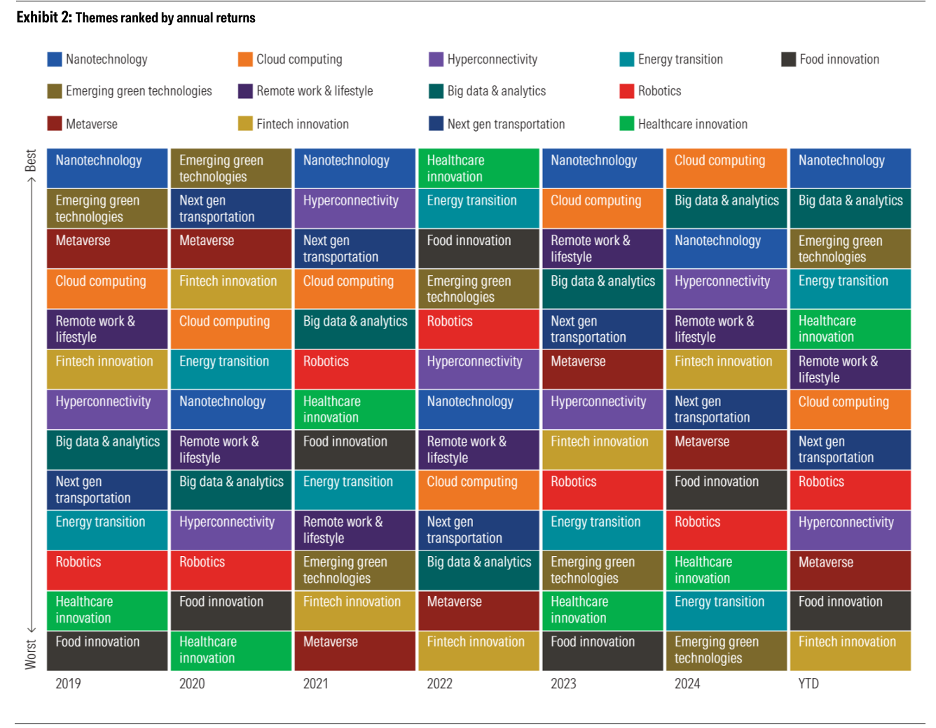
On an absolute return basis, performance across themes, as measured by the Morningstar Thematic Indexes, is mixed. No single theme consistently dominates performance year after year. Leadership rotates meaningfully across time, underscoring the challenges of timing a specific theme and the potential value of a rotation-based approach.
The excess-return correlation matrix indicates relatively low cross-theme co-movement after controlling for broad market effects, with pairwise correlations ranging from -0.46 to 0.84. Active share analysis further highlights substantial dispersion in constituent exposures, with several theme pairs exhibiting 100% active share, indicating no overlap in holdings. This heterogeneity in underlying exposures suggests that a systematic rotation framework may effectively capture shifts in thematic leadership and enable more efficient risk redistribution.
©2026 Morningstar. All Rights Reserved. The information, data, analyses and opinions contained herein (1) include the proprietary information of Morningstar, (2) may not be copied or redistributed, (3) do not constitute investment advice offered by Morningstar, (4) are provided solely for informational purposes and therefore are not an offer to buy or sell a security, and (5) are not warranted to be correct, complete or accurate. Morningstar has not given its consent to be deemed an "expert" under the federal Securities Act of 1933. Except as otherwise required by law, Morningstar is not responsible for any trading decisions, damages or other losses resulting from, or related to, this information, data, analyses or opinions or their use. References to specific securities or other investment options should not be considered an offer (as defined by the Securities and Exchange Act) to purchase or sell that specific investment. Past performance does not guarantee future results. Before making any investment decision, consider if the investment is suitable for you by referencing your own financial position, investment objectives, and risk profile. Always consult with your financial advisor before investing.
Indexes are unmanaged and not available for direct investment.
Morningstar indexes are created and maintained by Morningstar, Inc. Morningstar® is a registered trademark of Morningstar, Inc.